


Have you ever thought, “Am I doing Intuitive Eating right?”
Or maybe, “Is Intuitive Eating a cult, actually?”
This line of questioning is often part of what happens when you start Intuitive Eating.
In a world that openly celebrates weight loss for any reason — and at any cost — choosing not to diet or control our food can leave us second-guessing ourselves.
Our own ambivalence about the process often amplifies this internal battle. It’s normal to hold complicated feelings. A part of us may see and truly value the freedom, peace, and relief that Intuitive Eating offers. Honouring our food needs and body realities, especially if we are in a larger or stigmatized body, also isn’t an effortless endeavour. But while dieting gets harder with time, recovery’s silver lining is that things do get easier with practice and experience.
To shed some light on the process and create containment, I’ve outlined several experiences that tend to happen when you start Intuitive Eating:
You will probably enter the process hoping to lose weight.
Most of the people I work with hope they will lose weight during the process.
I think this makes so much sense given the associations and meaning we ascribe to thinness. Thinness is, in our culture, positively correlated with health, attraction, success or achievement, willpower, self-discipline, organization, good hygiene, and so on.
Folks who don’t lose weight through Intuitive Eating often feel that they must be doing something wrong or that Intuitive Eating isn’t for them. This can feel especially true if you’re still struggling in your relationship with food, or loved ones are skeptical of the model’s value and validity.
Keep in mind that the cultural idealization of thinness is an optimistic projection. Our culture projects all kinds of things on thinness, like good health or beauty or success, that thinness in and of itself can’t do. Yes, being in a more petite body does make things easier in all kinds of ways. That’s what we call thin privilege. But being in a small body doesn’t guarantee good health or a job promotion. Thinness can’t improve bone density, support regular digestion, or improve cardiovascular health. Thinness isn’t the same as obtaining an advanced degree to qualify for a higher-paying role. And being thin doesn’t guarantee that you will find love if you spend most of your time in your basement apartment.
Several things need to happen for someone to feel safe enough to let go of the pursuit of weight loss… which is why Intuitive Eating is a journey of embodiment, not something we can DIY our way into.
You’ll be afraid that you will never stop eating.
People generally fall into two camps when they start Intuitive Eating:
1. Those who fear they will never stop eating if they permit themselves (and continue to low-level restrict)
2. Those who let themselves eat more, but struggle with the guilt and shame that come with it.
Whether you’re recovering from a clinical eating disorder or dieting, keep in mind that you are coming off a period of semi-starvation and malnourishment. This holds true even if your presenting concern is overeating, binge eating, food obsession/preoccupation, compulsive eating, or “food addiction.”
As the Minnesota Starvation Experiment illustrates, increased appetite and hunger are hallmarks of recovery from semi-starvation. Your body is looking to replenish what was lost and rehabilitate from the effects of under-nourishment. It can’t distinguish between a self-imposed low-calorie diet and famine. In my experience, those in recovery from dieting or an eating disorder often have quite comparable re-nourishment experiences and go through very similar processes.
I understand how physically and psychologically taxing this time can be, as your body is often looking for more food than you’re actually hungry for (or even desire). Keep in mind that hunger and appetite levels do stabilize over time — we don’t get to decide when this will be or what it will look like. This can also be challenging if you’re accustomed to getting by on the calorie counts recommended by popular diets.
Food obsession will initially increase (and potentially later) during the process.
You may have spent considerable time during your dieting days thinking about your next meal. While it’s understandable that you would like to think about food less, you may find yourself thinking about it more initially as we work to (re)build your mind-body connection.
Intuitive Eating is a dynamic interplay of instinct, thought, and emotion, and it can take some time to think about eating in this way. I like to compare learning Intuitive Eating to learning how to drive a car. At first, it will consume a lot of your energy as you remind yourself to check your blind spots, watch for pedestrians, and get acquainted with highway driving. Over time, it gets easier.
Also, Intuitive Eating offers more food options, which can feel both exciting and anxiety-inducing. You may give more thought to which recipes you’d like to make or food you’d like to consume. You might choose to explore your valid food preferences and spend time connecting and learning how to respond to your body’s cues. An increase in obsession can also occur if you’re actively working through something specific in therapy, or a part of your system is feeling threatened by allowing yourself more liberty with food.
This doesn’t mean food peace is unavailable to you — it simply means more grounding, regulation, and safety are needed. This is also why I bring a trauma-informed, systems-oriented approach to nutrition counselling.
You’ll experience the “Intuitive Eating honeymoon.”
Most people experience the intense joys of an “all foods fit” approach initially and fall in love with the model. This time period is often referred to as the Intuitive Eating “honeymoon.” It can feel intensely liberating to stop restricting your food and eat.
You’ll realize that diet recovery is about so much more than food and weight.
Most people start the process of repairing their relationship with food and their bodies… but end up gaining so much more in return.
Some things you may navigate in your journey include: how to set and enforce boundaries, how to cope with strong emotions and discomfort using food and other strategies, naming and feeling your feelings, a more profound and more precise understanding of your relational patterns, a deep understanding of your core values, what self-care really means, and greater clarity around professional and personal goals and desires.
I’ve had clients return to school, change careers, pursue creative ambitions, build businesses, date, get engaged and married, have children, decide not to have children, move to another city or country, and more. Of course, many people move through Intuitive Eating without such dramatic changes. Still, I often like to say that Intuitive Eating is the gateway to intuitive living and greater self-trust. Our relationship to our plates is intimately connected to all of the other relationships in our lives.
You’ll notice several voices duking it out in your mind.
As you move through the process, you may notice more internal battling than in the past. The diet part or the eating disorder part may rage against your growing Intuitive Eating voice.
According to the Internal Family Systems model, we have “protective parts” within us that manage our life for us because they don’t trust our competent adult Self to do it (in a nutshell). These protectors might skip meals, engage in various diets, develop Orthorexic-like belief systems, get you to step on the scale regularly, over-exercise, and so on.
Most people will say that they don’t trust themselves around food or don’t know how to eat without a protocol to follow. In this way, dieting (and its iterations) manages our eating, and we follow the directions. Of course, we can only rely on “willpower” and self-discipline for so long until another part within us hijacks the plan.
When we start Intuitive Eating — which is a self-directed eating process — the protectors will begin firing. But white sugar is bad for you! You can’t keep eating like that! They will say all kinds of things to get you “on track” and back into the familiar arms of dieting.
As we help you to build more confidence with food, debunk nutrition and health myths, and reveal the function of these protective parts, we can channel compassion for the role dieting has played in our lives and restore self-trust with food and our bodies.
You will struggle to a) explain Intuitive Eating to people and b) defend your case.
Often, people want to explain what they’re doing to family, partners, and loved ones. It’s so understandable that you’d like to share what you’re doing with those in your life. At the same time, it can be tricky to explain Intuitive Eating (many people don’t understand the process, believe they are eating intuitively themselves, or can’t comprehend the idea of not pursuing weight loss.) Many people struggle to defend the case for Intuitive Eating. You’ll become more aware than ever of just how much clout the diet industry carries and just how deeply embedded fat hate is in our culture.
You’ll have days when you’re all in — and days when you seriously question whether the process is working.
Ambivalence is normal through each stage of the process. It’s common to experience denial, anger, grief, acceptance, depression, and more as you navigate Intuitive Eating. I find that the back-and-forth diminishes over time as you develop more confidence and security with Intuitive Eating.
The siren song of diet culture will tempt you.
It’s easy to romanticize dieting and view the past through rose-coloured glasses. Eating was more straightforward. Return to your reasons for starting this process. Remember that if the way you were eating before were completely satisfying, you wouldn’t have sought out Intuitive Eating.
Body image discomfort increases.
Because food work typically occurs before body image work, you may notice an increase in body image discomfort as you move through the process. I will often weave body image work through the initial stages to help us along, but it is common to feel more uncomfortable in your body before you feel some relief. This is because you no longer have those “protective” dieting parts to take you out of the discomfort.
Instead, we start to feel more: more emotion, more sensation, more of our body, more of our experience. It can feel this way even if your physical body hasn’t changed much. Body image work also takes time to truly steep. You can’t magically think your way to safety or know how to cope with sadness when you’ve never practiced before. This period can leave us feeling in “body image limbo” as we let go of dieting’s grasp and work on strengthening our body image.
You’ll wish you had discovered Intuitive Eating sooner.
Yes. While Intuitive Eating can be challenging at first, it does get easier. Most often, people tell me that they wish they had discovered Intuitive Eating sooner or that they had never started dieting. As you move through the work and begin to trust food and your body, you’ll understand and feel the futility of dieting. You’ll gain clarity on how destructive dieting has been in your life, how it steals the lives (literally or figuratively) of others, and ultimately profits from our insecurities and attachment wounds.
You’ll want to tell everyone you know about Intuitive Eating, and you might.
A bit cheeky, perhaps, but many people want to tell everyone they know about Intuitive Eating and yell it from the rooftops. This enthusiasm is so beautiful, of course, but keep in mind that as far as you have come, others may not have come very far (if at all.) Not everyone is on the same path or will be as receptive to hearing about Intuitive Eating. That’s okay.
You might have a love/hate relationship with your scale.
Maybe you throw your scale in the garbage only to get another, or weigh yourself regularly until you feel safe enough to reduce. People have different relationships with their scale (or tightest pair of pants or measuring tape). My recommendation is always to trash it, but I totally understand when folks tell me they aren’t ready or can’t get rid of it quite yet (there’s always a reason for this — and it may not be what you expect.)
All the feelings come to the surface.
You’ll find you start feeling so much. Because we no longer have our behaviours to cope with and numb, we start feeling so much more. We’re more fully in our bodies. We might feel untethered or out of control. What’s more likely is that all the feelings are flooding to the surface, and we may not yet have the tools to know what to do with them. This is where therapy can be invaluable, as can somatic practices that help to bring a felt sense of safety to the autonomic nervous system.
You’ll have epiphanies or “aha” moments.
As you become more intuitive with food, you’ll notice what’s working well and what’s working less well in your life. You may more clearly see how events in your past laid the groundwork for disordered eating, and how situations and experiences that were “too much” or “not enough” in the past have shown up in your relationship with food.
You’ll feel like things aren’t moving fast enough.
I’ve never met someone who dieted or struggled with an eating disorder and had an easy time relaxing and slowing down. Usually, we’re comfortable overworking, achieving, pushing past our limits, denying or delaying our needs, and generally prioritizing external concerns over internal ones (again, these are generalizations.) But to really get somewhere with Intuitive Eating, it takes time and effort. You can’t undo thirty years of dieting in three months or a ten-year eating disorder in a handful of weeks. By going slowly, we can really get into the weeds of what’s keeping you stuck in diet land and help you move forward.
Want out of the diet cycle for good? Here’s how we can work together:
- Work with me 1:1. Together we’ll review your current relationship with food and your body, discuss your goals for our time together, and help you to feel safe with food and your body without #dietmath.
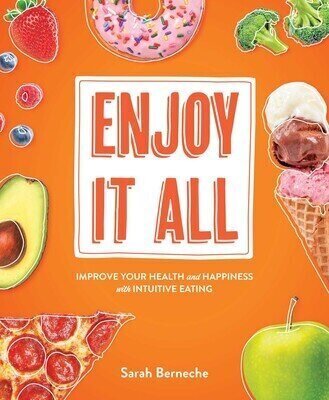
- New to Intuitive Eating and a non-diet approach? My book, Enjoy It All: Improve Your Health and Happiness with Intuitive Eating, offers a guide to finding lasting peace with food.

Nutritionist, Certified Intuitive Eating Counsellor, and Somatic Experiencing Practitioner specializing in disordered eating, body image, and food-related trauma.



Comments +